The forgotten genius who discovered that every living pathogen vibrates at a precise frequency —
and that transmitting that exact frequency back at it destroys it completely.
In the early 20th century, a self-taught scientist working out of San Diego, California made
discoveries that should have revolutionized medicine. Dr. Royal Raymond Rife built the world's
most powerful light microscope, became the first person to observe a living virus, and developed
a technology capable of destroying pathogens using precisely tuned electromagnetic frequencies —
with no drugs, no side effects, and no harm to surrounding healthy tissue.
Rife's work was not speculative. It was documented, witnessed by prominent physicians and
scientists, and validated in controlled clinical trials. In 1934, a special cancer committee
of the University of Southern California oversaw the treatment of 16 terminal cancer patients
using Rife's technology — and reported complete recovery in all 16 cases within 90 days.
Yet today, almost no one in mainstream medicine has heard of him. His laboratory was raided
and destroyed. His colleague was found dead under suspicious circumstances. His business
partner was imprisoned. The Royal Rife story is one of the most consequential episodes of
scientific suppression in modern history.
"Every living organism has a peculiar and, we are convinced, characteristic vibratory
rate. Our new microscope shows us that this rate is as definite and constant as an
atomic structure. If we can produce these vibrations in sufficient intensity, we may
devitalize the disease organism."
Born in rural Nebraska, Rife had no formal university degree in biology — yet his experimental
precision, optical ingenuity, and relentless documentation put him far ahead of the credentialed
establishment of his era.
May 16, 1888
Born in Elkhorn, Nebraska
Royal Raymond Rife is born into a modest Midwestern family. From childhood he shows an
extraordinary aptitude for mechanical and optical devices.
~1905–1910
Studies Optics at Carl Zeiss, Germany
Rife travels to Germany to study under the master opticians at Carl Zeiss, gaining
deep expertise in the grinding and calibration of precision optical lenses — skills
that would define his life's work.
~1912
Settles in San Diego, California
Rife establishes a private laboratory in Point Loma, San Diego, funded largely by
Henry Timken, the wealthy industrialist and inventor. With Timken's patronage, he
is free to pursue science without commercial pressure.
1920
Builds His First Rife Microscope
Using his expertise in optics, Rife completes a prototype microscope of unprecedented
magnification and resolution — capable of viewing organisms that conventional microscopes
cannot resolve.
1931
Completes the Universal Microscope
His masterwork — an instrument of 5,682 parts with a magnification of up to 60,000×
— is completed and demonstrated to members of the medical establishment, including
Dr. Arthur Kendall of Northwestern University. The two scientists jointly observe
living viruses for the first time in history.
1934
The USC Cancer Clinical Trial
Under the supervision of a Special Medical Research Committee of the University of
Southern California, sixteen terminal cancer patients are treated with Rife's
Frequency Instrument. All sixteen recover within ninety days.
1939
Confrontation with the AMA
Dr. Morris Fishbein of the American Medical Association approaches Rife with an offer
to co-invest in his technology. Rife refuses. Within months, the systematic destruction
of his work begins.
1939–1950
Suppression and Collapse
Rife's laboratory is broken into. Key specimens and equipment are stolen or destroyed.
His colleague and champion, Dr. Milbank Johnson, dies under suspicious circumstances.
Physicians using Rife's technology are threatened with loss of their medical licenses.
1950s–1960s
Isolated and Broken
John Crane, Rife's business partner and the man attempting to commercialize his
technology, is arrested and sentenced to three years in federal prison. Rife
descends into alcoholism and virtual obscurity.
August 5, 1971
Death in El Cajon, California
Rife dies largely unknown in a hospital in El Cajon. His notebooks, documentation,
and equipment are either lost, stolen, or destroyed. The full extent of his discoveries
is not widely known until author Barry Lynes publishes The Cancer Cure That Worked
in 1987.
Rife's Point Loma laboratory, San Diego — equipped with his custom frequency instruments and microscopes, circa 1930s.
A Scientist Before His Time
Rife held over 68 patents spanning optics, electronics, and instrumentation. He built custom
precision equipment at every stage — grinding his own lenses, hand-winding his own coils,
and designing circuits decades ahead of the commercial electronics industry. His lab tools
were so accurate that the U.S. Navy contracted him during World War I to help identify
enemy submarine technology.
Section 2
The Universal Microscope
Built over a decade of painstaking optical engineering, the Universal Microscope was the
instrument that made everything else possible. It remains, in many respects, unmatched by
any optical microscope built since.
Conventional optical microscopes of the 1920s could magnify specimens to approximately
2,500× before diffraction limits — the wave nature of visible light itself — blurred the
image beyond use. Electron microscopes, which would be developed in the 1930s, could
magnify far more, but required the specimen to be killed, stained, and placed in a vacuum.
They could never observe a living organism in its natural state.
Rife solved this by developing a system using two sets of quartz prisms
as monochromatic light filters. Rather than illuminating a specimen with broad-spectrum white
light, his microscope tuned the illuminating frequency to the natural vibrational
resonance of the organism being observed. At resonance, the specimen itself emitted a
characteristic color — a unique optical fingerprint — allowing it to be seen with extraordinary
contrast against the background.
🔩
5,682 Parts
Hand-assembled over years in his San Diego workshop. Every component custom-manufactured.
🔍
60,000× Magnification
Far exceeding any other optical microscope. Electron microscopes at the time reached ~2,000×, but killed specimens.
🧬
First to See Living Viruses
Rife and Dr. Arthur Kendall of Northwestern were the first scientists to observe a living, moving virus.
🌈
Resonant Illumination
Monochromatic light tuned to each organism's vibrational frequency — making it glow in its own characteristic color.
"We can now see organisms which no other microscope in existence can show us. Each one
has its own characteristic color — a color which is entirely the product of its own
frequency."
— Dr. Royal Rife to Dr. Milbank Johnson, 1932
Rife Universal Microscope — Illustrated reconstruction. The blue rings represent the quartz prism monochromatic filter system.
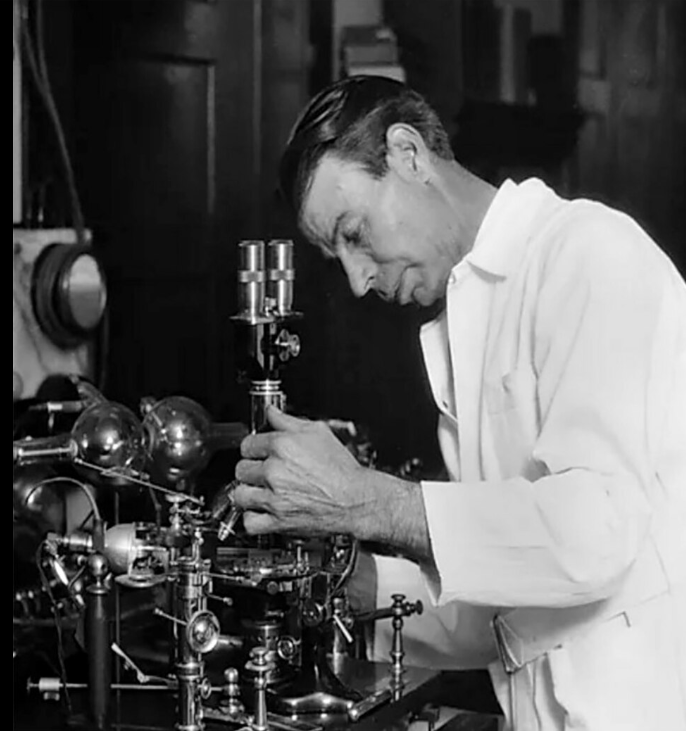
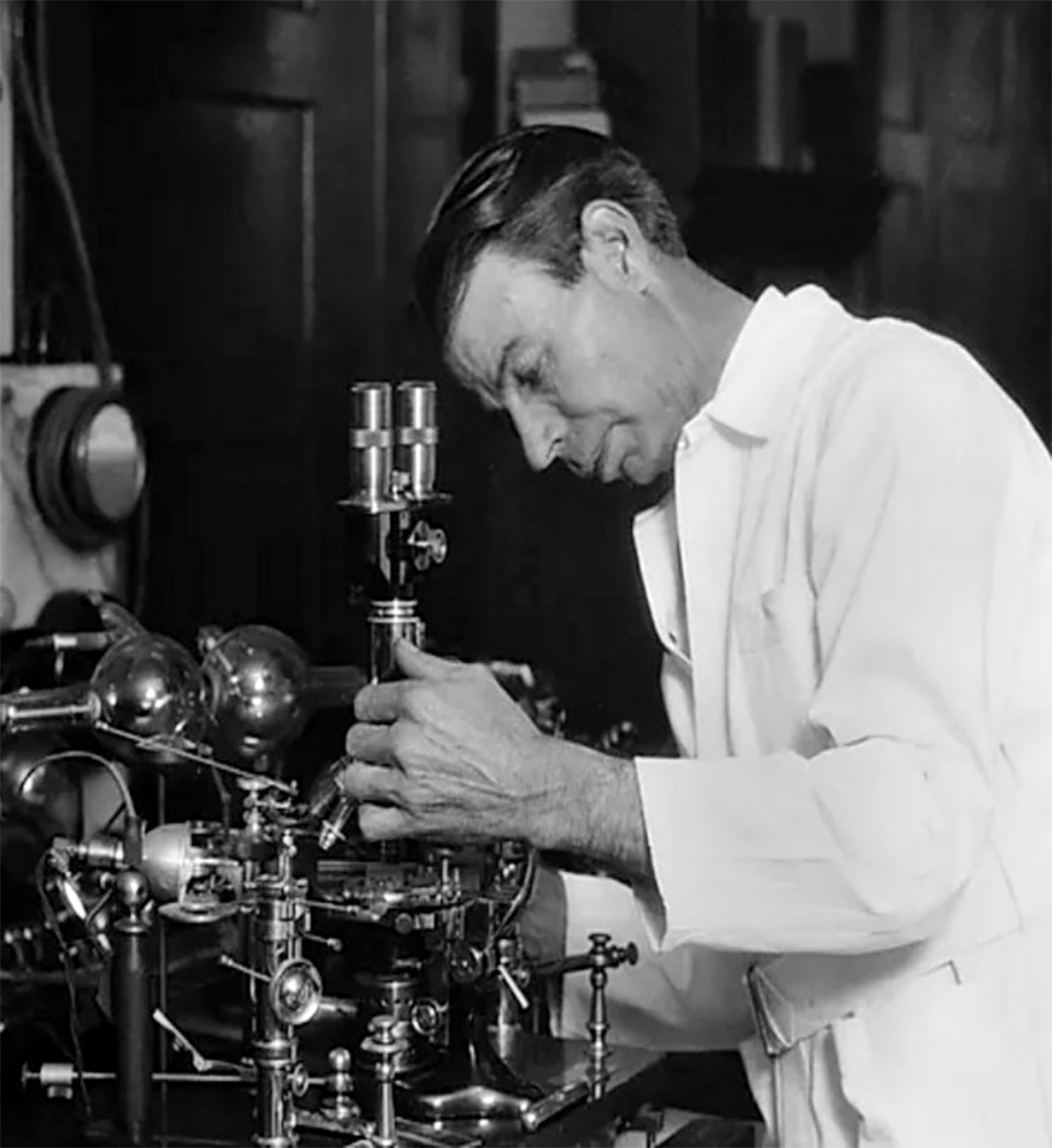
Dr. Rife in his laboratory with his microscope and plasma frequency device, November 1929. Photo: Wikimedia Commons, CC BY-SA 4.0.
Section 3
The Frequency Instrument & Mortal Oscillatory Rate
After identifying pathogens through his microscope and characterizing their optical resonances,
Rife made a logical leap: if an organism resonates at a particular electromagnetic frequency,
a sufficiently strong transmission of that same frequency should cause it to resonate itself
to pieces — much like a singer shattering a crystal wine glass.
The Cymatics Principle
Every physical structure — from a bridge to a microorganism — has a natural resonant
frequency. This is the frequency at which it most readily absorbs vibrational
energy. At this frequency, vibrations reinforce each other in what engineers call resonance
amplification. If energy at that frequency is supplied continuously, the structure's
own vibrations grow until its mechanical integrity fails and it breaks apart.
The most familiar example is the Tacoma Narrows Bridge collapse of 1940,
where wind at the bridge's resonant frequency caused oscillations that grew until the
structure tore itself apart. The opera singer breaking a glass works on exactly the same
principle. Rife applied this concept to microbiology.
He called the precise destructive frequency for each organism its
Mortal Oscillatory Rate (MOR). Using his microscope, he could observe
organisms in real time as he increased and changed the transmitted frequency. When the
MOR was reached, the organism became agitated, then distorted, and then ruptured — often
explosively, scattering its cellular contents under the microscope field.
"In short, I found that certain frequencies of electrical energy would kill the
typhoid bacillus, while others would kill the streptococcus, and still others
the pneumococcus — all in a few minutes. The frequencies were as specific as
fingerprints."
— Dr. Royal Rife, personal notes, circa 1938
The Rife Frequency Instrument — a custom vacuum-tube radio frequency generator
capable of transmitting precise electromagnetic frequencies through a plasma tube applicator.
The Science in Three Steps
🔬
Step 1: Identify the Pathogen's Frequency
Using the Universal Microscope with resonant illumination, each organism reveals its
characteristic color and vibrational fingerprint. This becomes its known frequency signature.
📻
Step 2: Transmit the MOR
The Frequency Instrument generates the pathogen's Mortal Oscillatory Rate — often an
audio-range frequency modulated onto a radio carrier wave — and broadcasts it through a
plasma tube applicator near the patient.
💥
Step 3: Resonant Structural Collapse
The pathogen absorbs energy at its resonant frequency. As internal oscillations grow
beyond structural tolerances, the cell membrane ruptures. The organism is destroyed
while surrounding healthy cells — vibrating at entirely different frequencies — are
completely unaffected.
⚠ Key Distinction: Unlike antibiotics, which indiscriminately damage both
pathogens and beneficial microflora, resonant frequency therapy is claimed to be highly
frequency-specific. Only organisms vibrating at or near the targeted MOR are affected.
Healthy human cells, vibrating at entirely different frequencies, are not disturbed.
This is the foundational claim that makes Rife's work so significant — and so threatening
to pharmaceutical-model medicine.
Section 4 · Interactive
Live Frequency Simulation
This interactive model demonstrates how increasing electromagnetic frequency affects a
pathogen cell. Drag the frequency slider upward toward the Mortal Oscillatory Rate (728 Hz,
the documented MOR for the BX carcinoma virus) to observe the resonance effect.
⚡ RIFE FREQUENCY RESONANCE SIMULATOR
TARGET ORGANISM — BX Carcinoma Virus
● IDLE — No Resonance
MOR Target: 728 Hz (BX Cancer)
0
HERTZ (Hz)
0 Hz400 Hz800 Hz
Status: No frequency transmitted. Organism is in its resting state.
NOTE:
This is a conceptual simulation for educational purposes. Actual Rife therapy uses
audio frequencies modulated onto a radio frequency (RF) carrier wave.
The BX carcinoma virus MOR of 728 Hz is among the most cited in Rife's documented research.
Section 5
The 1934 USC Clinical Trial
In the summer of 1934, the Special Medical Research Committee of the University of Southern
California conducted the most remarkable cancer trial ever recorded. Sixteen patients — all
diagnosed with terminal cancer — were treated exclusively with Rife's frequency instrument.
The clinical trial was organized by Dr. Milbank Johnson, a prominent Los Angeles physician,
and held at a facility near the Scripps ranch outside San Diego. Each patient received
three-minute treatments, three times per week, with Rife's frequency instrument calibrated
to the specific pathogens identified in their case.
The rationale for the three-minute, every-other-day schedule was deliberate: continuous
application, Rife found, could overwhelm the body's ability to clear the dead pathogenic
material. Spacing treatments allowed the lymphatic and excretory systems to flush the
cellular debris before the next session.
The conclusion of the Special Committee: "Since the treatment is
non-toxic, harmless, and appears to be effective, we recommend that it be given every
consideration by the medical community."
The results were witnessed by sixteen attending physicians and documented in the committee
report. Dr. Johnson announced the results publicly and arranged for a celebratory banquet
in Rife's honor attended by forty-four of the leading medical figures in California.
Five years later, after Rife refused to sell his technology to the American Medical
Association, that same medical establishment would work systematically to erase these
results from the scientific record.
16
Terminal cancer patients enrolled
14
Declared fully recovered after 70 days
16 / 16
All patients recovered by 90 days
3 min
Treatment duration per session, 3×/week
⚠ Historical Note: The original trial documentation was destroyed or
went missing following the systematic suppression of Rife's work in the late 1930s.
The accounts preserved today come from contemporaneous physician correspondence,
the records of Dr. Milbank Johnson, and Barry Lynes' 1987 investigative work
The Cancer Cure That Worked.
Section 6
Documented Rife Frequencies
The following frequencies are drawn from Rife's original research notes, laboratory journals,
and the subsequent documentation by his associates. They represent the audio-range component
of the frequency instrument's output, which was typically modulated onto a radio carrier wave.
Organism / Condition
Classification
Rife MOR Frequency
Notes
BX — Carcinoma Virus
Virus
728 Hz
Primary cancer-associated organism; Rife's most studied MOR
BY — Sarcoma Virus
Virus
784 Hz
Related pleomorphic form; secondary MOR also at 2,008 Hz
Herpes Simplex Virus
Virus
1,552 Hz
Documented in Rife's 1935–1938 research journals
Staphylococcus aureus
Bacteria
727 Hz
Common skin and wound pathogen; near BX MOR
Streptococcus
Bacteria
880 Hz
Responsible for strep throat, scarlet fever, and related conditions
Escherichia coli (E. coli)
Bacteria
303 Hz
Common intestinal pathogen; lower-frequency range
Bacillus typhosus (Typhoid)
Bacteria
760 Hz
Among the earliest organisms Rife successfully devitalized
Mycobacterium tuberculosis
Bacteria
803 Hz
Tuberculosis organism; documented in joint Rife-Kendall sessions
Candida albicans
Fungus
465 Hz
Common yeast overgrowth; secondary frequencies at 1,479 Hz
Aspergillus (mold family)
Fungus
432 Hz
Indoor mold associated with respiratory and systemic illness
Ascaris lumbricoides (roundworm)
Parasite
444 Hz
Most prevalent human intestinal parasite worldwide
Plasmodium (Malaria)
Parasite
1,489 Hz
Rife documented successful devitalization in laboratory specimens
⚠ Disclaimer: The frequencies listed above are drawn from historical research
documents and are presented for educational and historical purposes only. They have not been
independently verified or approved by the FDA. Modern Rife practitioners often use updated
frequency sets based on refined research. Consult a qualified practitioner before use.
Dr. Houck's Frequencies — From Rife's Foundation to Clinical Practice
Rife's original Mortal Oscillatory Rates were only the beginning. Over decades of clinical
work, Dr. Russ Houck built upon that foundation — testing, refining, and expanding the
frequency database far beyond what Rife's era could catalogue. Where Rife documented
a handful of organisms under his Universal Microscope, Dr. Houck's working list spans
over 122 curated frequency items covering bacterial, viral, fungal, and
parasitic pathogens alongside organ-support, structural, neurological, and hormonal protocols.
Each entry in Dr. Houck's list earned its place through repeated, observable results in
real clinical settings — not theoretical derivation. His frequencies are stored in the
Wave-Z database alongside four other major frequency databases: the Consolidated Annotated Frequency
List (CAFL), the General Frequency List, the Electro Therapy Device Frequency List (ETDFL),
and the DNA Frequency List — together totalling over 66,000 individual frequencies
across more than 6,300 named conditions.
Dr. Houck's list represents a practitioner's distillation of frequencies observed to be
consistently useful across decades of personal and clinical application — translated directly
into a device-ready frequency library for the Wave-Z MiniMax.
Educational Use Only:
The frequencies and protocols described here are not approved by the U.S. Food & Drug
Administration and are not intended to diagnose, treat, cure, or prevent any disease or
medical condition. All information is provided for historical, educational, and research
purposes only. Consult a licensed healthcare professional before beginning any
frequency-therapy program.
The systematic dismantling of Rife's work stands as one of the most well-documented cases of
scientific and medical suppression in the 20th century. What followed the 1934 clinical trial
was not celebration — it was destruction.
Timeline of Suppression
1934–38
Following the USC clinical results, fourteen physicians who had treated patients with
Rife's frequency instrument are visited by representatives of the AMA. Each is
threatened with loss of their medical license if they continue using
or publicizing the technology.
1939
Dr. Morris Fishbein, the powerful editor of the Journal of the American
Medical Association, approaches Rife and offers to purchase a controlling interest in
his company. Rife refuses. Fishbein subsequently publishes articles dismissing Rife's
work as fraudulent — articles that are reprinted without scrutiny by major newspapers.
1939
Dr. Milbank Johnson, Rife's most prominent champion and the organizer of the USC trial,
is found dead on the eve of his planned press conference announcing the
final results of the cancer study. His death is ruled natural, but his papers and the
trial documentation disappear.
1940
Rife's laboratory in Point Loma, San Diego, is broken into. Critical
microscope components and frequency research files are stolen. Rife's most important
associate, Dr. Arthur Kendall of Northwestern University, abruptly drops all
collaborative work without explanation.
1953–56
John Crane, Rife's business associate who had attempted to manufacture
and distribute updated Rife instruments, is arrested. Despite presenting affidavits
from numerous physicians attesting to the technology's efficacy, Crane is
convicted and sentenced to three years in federal prison.
1960s
Rife, now alcoholic and impoverished, retreats first to Tijuana, Mexico, and then
to El Cajon, California. His remaining instruments are lost or sold to pay debts.
He lives out his final years in obscurity. His former laboratory is demolished.
1987
Investigative journalist Barry Lynes publishes The Cancer Cure
That Worked, reconstructing the history of Rife's discoveries and their
suppression from surviving documents. The book reignites worldwide interest
in Rife's technology and inspires a new generation of frequency researchers.
The Pleomorphism Question
Central to Rife's worldview was a theory called pleomorphism — the idea
that microorganisms can change form depending on the pH and nutritional environment of
their host. Rife believed the BX and BY cancer viruses were actually the same organism
in different morphological states, driven by a diseased internal terrain. This view,
shared by Antoine Béchamp a century earlier, directly contradicted the Pasteurian
"one germ, one disease" model that undergirds the pharmaceutical industry. If Rife
and Béchamp were correct, the therapeutic target shifts from external drug intervention
to internal biological environment — a framework incompatible with a patent-based
pharmaceutical economy.
Rife's Point Loma Laboratory
San Diego, California — destroyed 1940 "All the work of 20 years, gone in a single night." Wikipedia ↗
Rife's Point Loma laboratory — the site of his most important discoveries —
was broken into in 1940. Critical specimens, frequency records, and custom microscope
components were taken and never recovered.
"I have spent every dollar I ever made in my life trying to give this to the
world. I have lost my health and my family over it. And they destroyed it."
— Dr. Royal Raymond Rife, in a letter to John Crane, 1958
Section 8
Modern Rife Technology
In the decades since Barry Lynes revived interest in Rife's work, a global community of
researchers, engineers, and natural health practitioners has worked to reconstruct and refine
his technology using modern electronics. The result is a new generation of frequency instruments
that are far more precise, reproducible, and reliable than the original vacuum-tube devices.
Modern Rife devices use digital frequency synthesis, precision waveform generators, and
updated frequency databases compiled from decades of practitioner feedback and research.
Where Rife's original instruments operated through plasma tubes held near the body,
contemporary devices deliver frequencies through direct contact electrodes, plasma ray tubes,
and PEMF (pulsed electromagnetic field) coils — offering multiple modalities for different
applications and conditions.
At Eden Natural Health, Dr. Houck has spent over eight years developing and refining
the Wave-Z™ line of Rife frequency instruments — built on the scientific
legacy of Royal Rife but incorporating modern engineering for clinical-grade precision.
The Wave-Z™ family of instruments carries Rife's vision into the 21st century —
precision digital frequency synthesis, a comprehensive library of researched frequencies,
and robust build quality designed for consistent therapeutic use. Each device is
individually calibrated and backed by Dr. Houck's clinical experience.
Barry Lynes, 1987. The definitive investigative account of Rife's discoveries and their
suppression. The book that reignited the Rife movement worldwide.
Compiled from original laboratory notebooks, correspondence, and court records by
researchers reconstructing Rife's frequency documentation in the 1990s and 2000s.
Eden Natural Health - Life Protocols (ENH-LP) and Dr. Houck do not attempt to diagnose, treat, or cure any type of disease or medical condition. ENH-LP is not a part of allopathic medical practices and does not give medical advice or practice any form of allopathic medicine.
ENH-Life Protocols, its advice, and recommended products are not approved by the FDA and are not medical in nature. Results will always vary with each individual. There are no ENH-LP guarantees or warranties, written or implied.
If you have a medical condition that requires treatment or a procedure by a medical professional, we recommend you consult the best medical professional you can find.
ZYTO Technology does not identify, diagnose, treat, or cure any disease or medical condition. ZYTO software has not undergone FDA review for effectiveness. ZYTO products have not been the subject of controlled clinical trials to establish their effectiveness and their use is not a generally accepted medical practice by the traditional medical establishment.